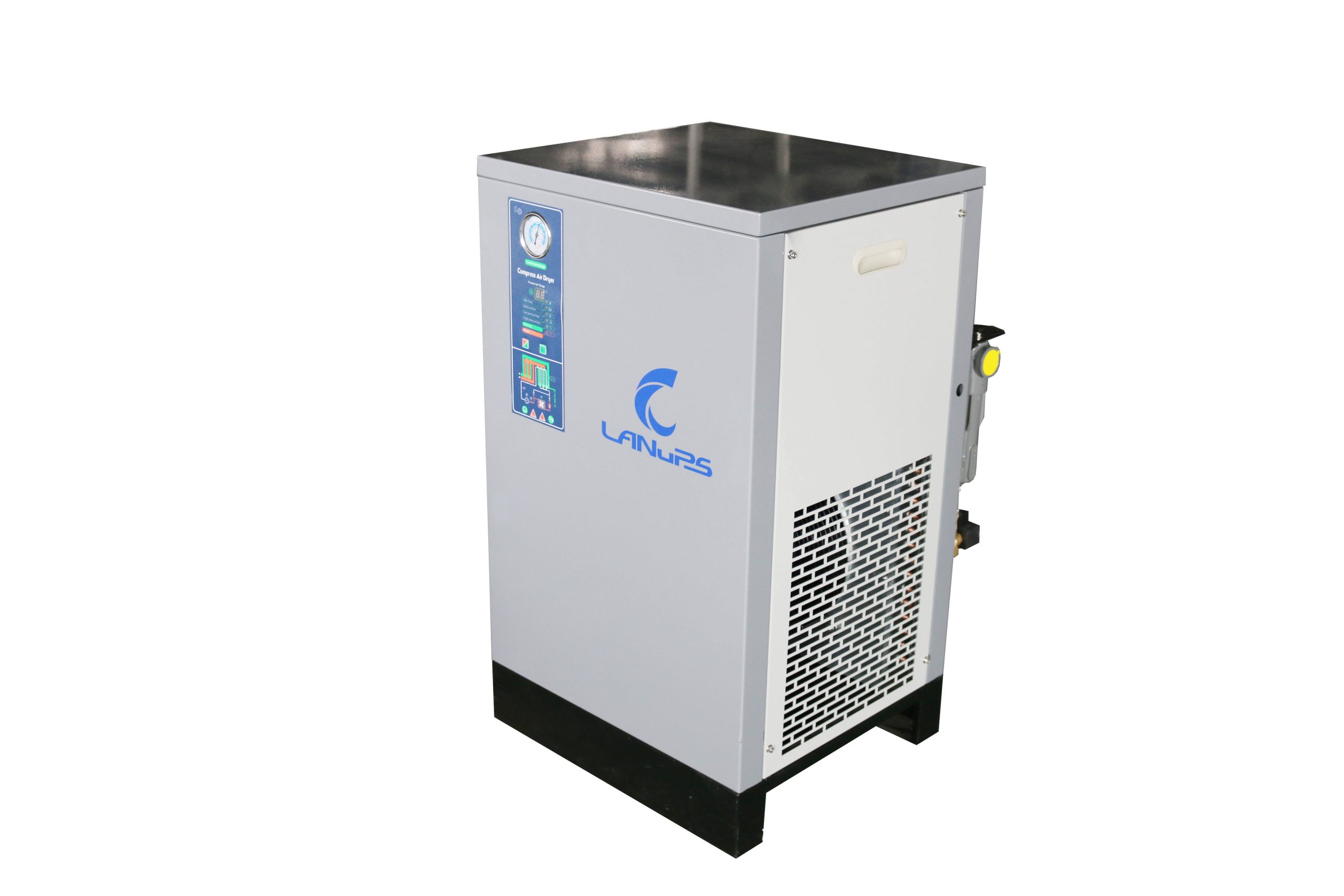
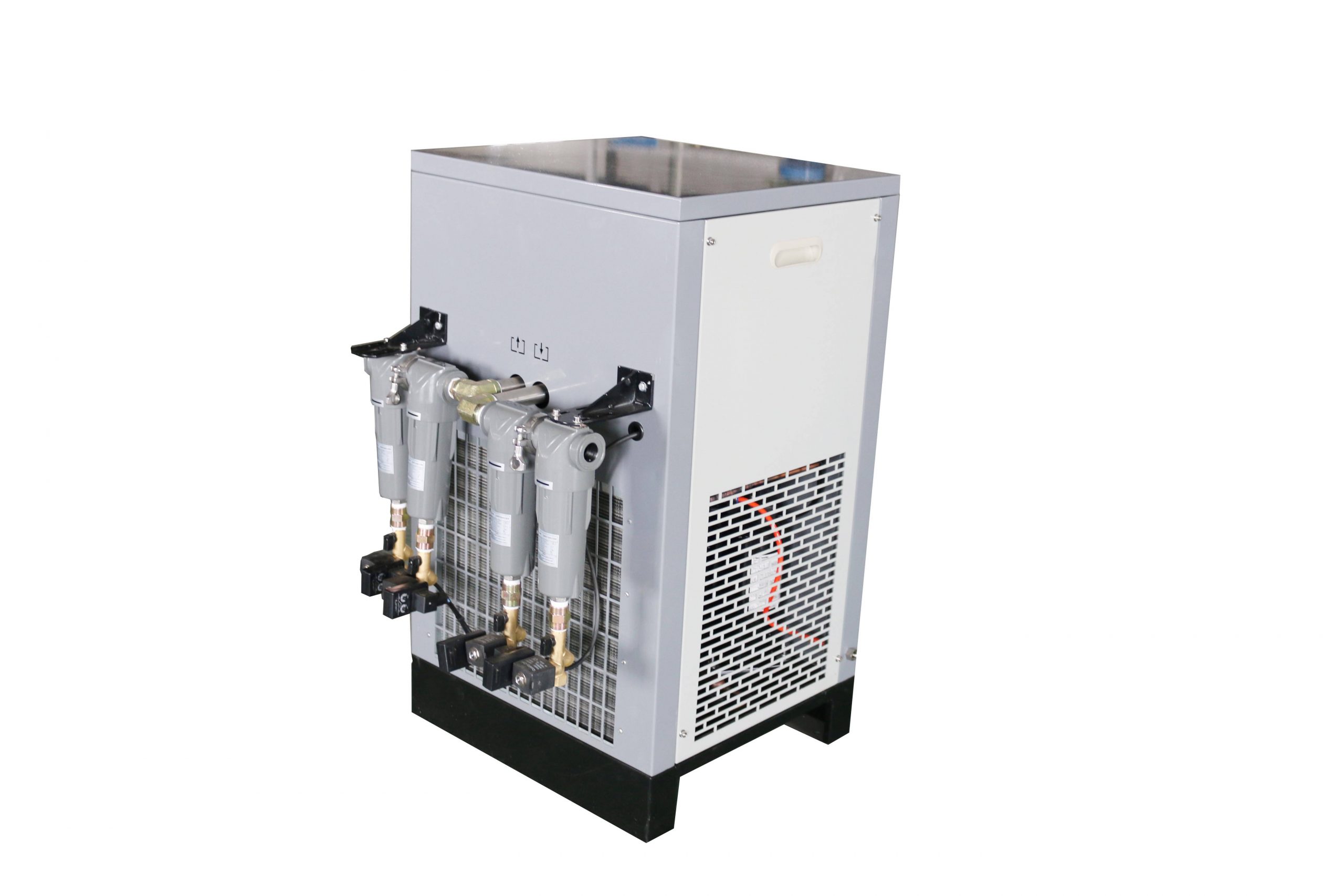
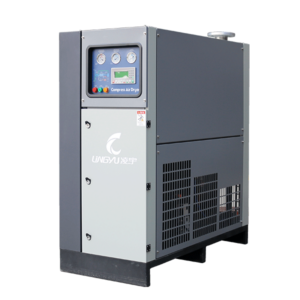
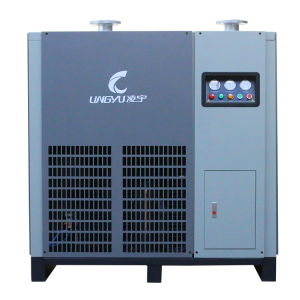
The high-pressure refrigerated air dryer is designed for compressed air systems that require stable moisture removal under elevated working pressure. It adopts a combined drying process of double-stage precooling, refrigeration, condensation, and five-stage gas-water separation to ensure reliable dew point performance and efficient condensate removal.
During operation, hot and moisture-laden compressed air first passes through the double-stage precooler, where part of the heat is removed before entering the refrigeration circuit. The air is then cooled further by the refrigerant system, causing water vapor to condense into liquid. After condensation, the compressed air passes through a five-stage gas-water separation system, which efficiently removes the condensed moisture and delivers dry compressed air to the downstream system.
With its air-cooled heat dissipation design, the dryer uses forced heat exchange between the ambient air and refrigerant to maintain stable operation. This structure helps ensure a consistent outlet air dew point of +2°C to +10°C, protecting pipelines, valves, pneumatic components, and end-use equipment from moisture-related problems.
To ensure stable drying performance and reliable long-term operation, the refrigerated air dryer should be used under the following recommended conditions:
- Applicable fluid: Compressed air, non-corrosive air
- Working principle: Double-stage precooler, refrigeration, condensation, five-stage gas-water separation
- Inlet air flow: Standard 2.5 Nm³/min to 150 Nm³/min
- Inlet air pressure: 10–16 bar
- Inlet air temperature: Standard 45°C, maximum 50°C
- Working environment temperature: Standard 32°C, range 2°C to 45°C
- Ventilation requirement: Good ventilation must be ensured
- Pressure loss at full load: Standard 0.2 bar
- Outlet air dew point: +2°C to +10°C
- Cooling method: Air cooling, using ambient air and refrigerant for forced heat dissipation
For the best operating result, the dryer should be installed in a clean and well-ventilated environment. Stable inlet conditions and proper system layout help maintain drying efficiency, reduce pressure loss, and improve equipment service life.
| Processing Capacity (m³/min) | Input Power (kW) | Connection Size | Weight (kg) | Dimensions (mm) L × W × H |
|---|
| 3.8 | 0.44–1.25 | G1½” | 105 | 1000 × 600 × 1050 |
| 7.0 | 0.48–1.42 | G1½” | 130 | 1100 × 600 × 1100 |
| 10.5 | 0.60–1.90 | G2″ | 155 | 1250 × 700 × 1155 |
| 13.5 | 0.80–3.60 | G2½” | 350 | 1400 × 850 × 1350 |
| 17.0 | 1.02–3.61 | DN80 | 450 | 1570 × 800 × 1200 |
| 21.5 | 1.02–4.03 | DN80 | 480 | 1500 × 950 × 1400 |
| 25.0 | 1.4–5.5 | DN80 | 530 | 1835 × 940 × 1480 |
| 28.5 | 1.40–6.20 | DN80 | 540 | 1835 × 940 × 1480 |
| 32.0 | 2.02–7.58 | DN80 | 560 | 1835 × 940 × 1480 |
| 37.0 | 1.83–6.75 | DN100 | 680 | 1900 × 980 × 1580 |
Note: For special specifications or requirements related to pressure, materials, temperature, or larger air volume, customized solutions are available. The above data is for reference only and may change without prior notice.
The high-pressure refrigerated air dryer is well suited for Middle East industrial environments where compressed air systems often operate under high ambient temperatures, dust exposure, and demanding continuous-duty conditions. With a working pressure range of 10–16 bar, an air-cooled design, and stable dew point performance of +2°C to +10°C, it is especially suitable for applications that require high-pressure dry compressed air rather than ultra-low-dew-point process air. In hot regional conditions, proper indoor installation and ventilation are especially important for reliable air-cooled operation.
Recommended Applications
- Laser Cutting Systems and High-Pressure Assist Air – Provide stable dry compressed air to help protect cutting heads, valves, and air-control components while supporting consistent cutting performance
- Metal Processing, CNC, and Fabrication Lines – Help reduce moisture-related corrosion and improve reliability in cutting, machining, and fabrication systems
- Automotive Component Manufacturing and Machinery Production – Supply dry high-pressure air for pneumatic controls, assembly systems, and workshop equipment
- High-Pressure Compressed Air Networks (10–16 bar) – A practical solution for air systems operating above the range of standard low-pressure refrigerated dryers
- Heavy Industrial Workshops and Processing Lines – Support reliable moisture removal for tools, valves, and downstream production equipment
- General Manufacturing Requiring Stable High-Pressure Dry Air – Improve air quality and reduce moisture-related downtime in continuous production environments
- Packaging and Industrial Utility Air Systems with Higher Working Pressure – Suitable for plant air systems where stable dew point and higher pressure operation are both required
- Central High-Pressure Air Systems in Multi-Line Factories – Help maintain stable compressed air quality across multiple production zones
Application Note for the Middle East
For Middle East installations, this model should be placed in a clean, well-ventilated indoor environment and used with proper pre-filtration and after-filtration. Because regional operating conditions often include heat extremes and airborne dust, good ventilation is especially important for maintaining the performance of the air-cooled condenser and for protecting downstream equipment in high-pressure systems.
Explore More Industry Applications