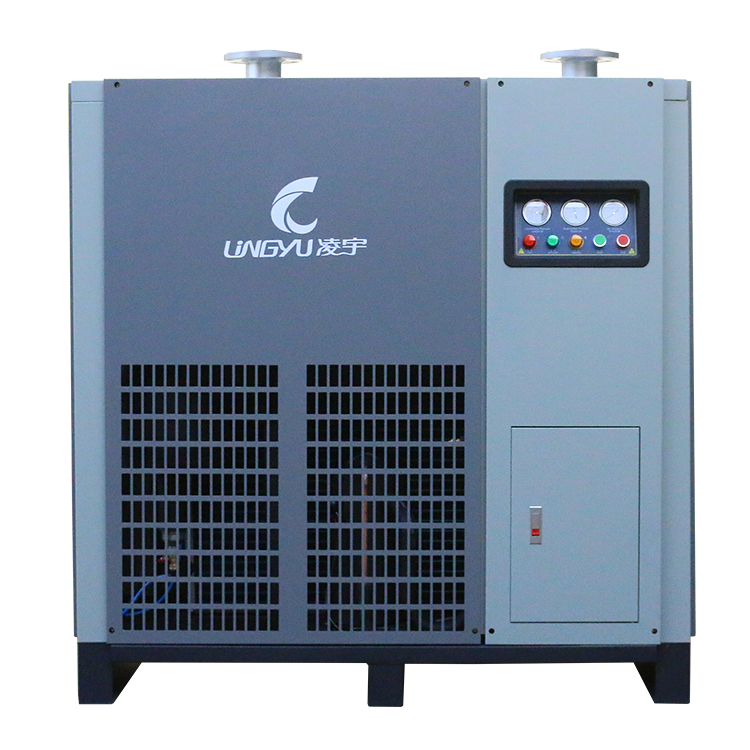
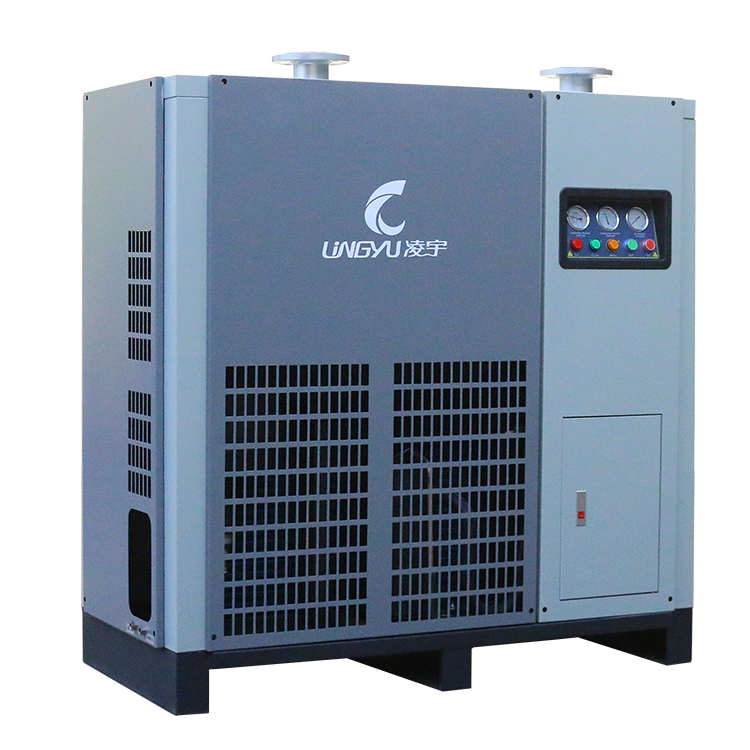
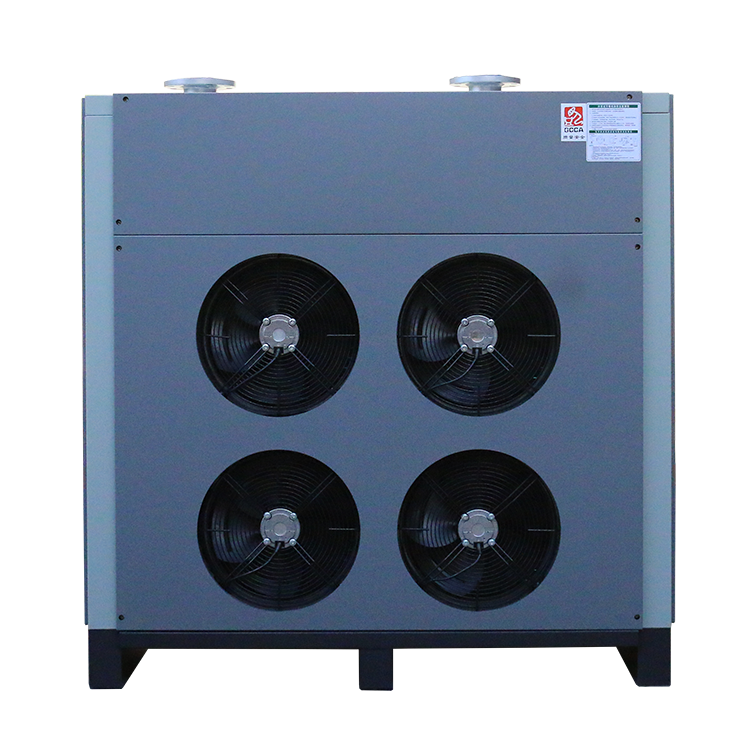
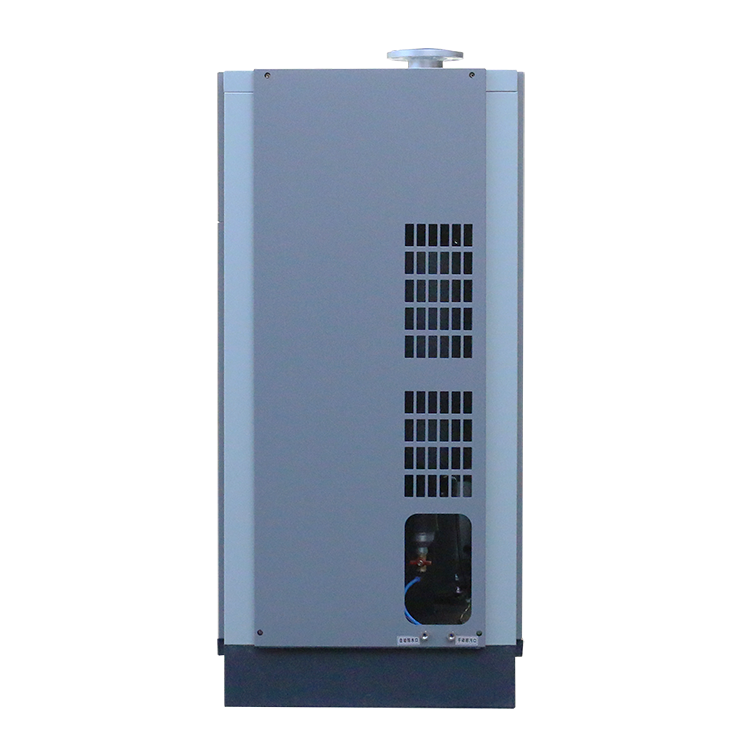
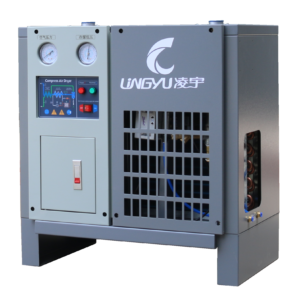
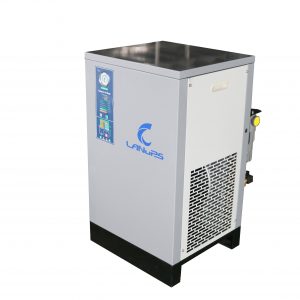
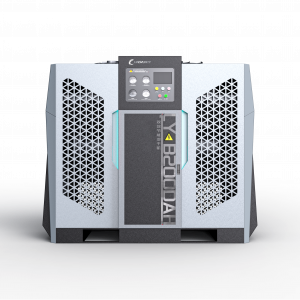
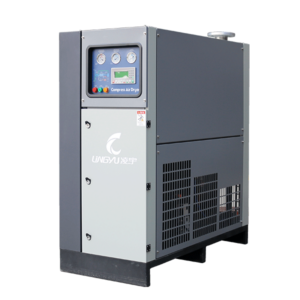
The Shell Tube Refrigerated Air Dryer is designed to provide stable and efficient moisture removal for industrial compressed air systems. It uses a refrigeration drying process to cool hot compressed air, condense water vapor, and separate the liquid moisture before the air enters downstream equipment.
During operation, compressed air passes through the internal heat exchange and refrigeration system, where its temperature is reduced to the required level. As the air cools, water vapor condenses into liquid water, which is then removed through the separation and drainage system. The dried air leaves the dryer with a stable pressure dew point of 2°C to 10°C, helping protect pipelines, pneumatic components, valves, and production equipment from moisture-related damage.
With its air-cooled design, the dryer provides reliable heat dissipation and stable performance under continuous industrial operating conditions. It is especially suitable for applications requiring dependable compressed air quality, moderate pressure loss, and long-term system reliability.
To ensure stable drying performance and reliable long-term operation, the Shell Tube Refrigerated Air Dryer should be used under the following recommended conditions:
- Applicable fluids: Compressed air, non-corrosive air
- Rated inlet pressure: 0.7 MPa
- Allowable pressure range: 0.6–1.0 MPa, other pressure levels customizable
- Rated inlet temperature: 50°C
- Maximum inlet temperature: ≤ 80°C
- Pressure loss under full load: < 0.025 MPa
- Outlet pressure dew point: 2°C–10°C
- Rated ambient temperature: 35°C
- Ambient operating range: 2°C–45°C
- Cooling method: Air-cooled
For the best operating result, the dryer should be installed in a clean and well-ventilated environment. Stable inlet conditions and proper system configuration help maintain drying efficiency, reduce pressure loss, and extend equipment service life.
| Processing Capacity (m³/min) | Power Supply and Voltage (V/Hz) | Total Power (kW) | Air Inlet and Outlet | Equipment Weight (kg) | Dimensions (mm) L × W × H |
|---|
| 1.5 | 220/50 | 0.68 | G1″ | 48 | 680 × 440 × 710 |
| 2.5 | 220/50 | 0.83 | G1″ | 58 | 800 × 440 × 800 |
| 3.8 | 220/50 | 1.10 | G1.5″ | 95 | 980 × 500 × 930 |
| 6.5 | 220/50 | 1.50 | G1.5″ | 110 | 1030 × 550 × 1000 |
| 10.5 | 220/50 | 2.20 | G2″ | 160 | 1240 × 650 × 1150 |
| 13.5 | 380/50 | 3.10 | G2.5″ | 225 | 1350 × 670 × 1300 |
| 17.0 | 380/50 | 3.10 | G2.5″ | 235 | 1350 × 670 × 1300 |
| 21.5 | 380/50 | 5.20 | DN80 | 295 | 1450 × 700 × 1510 |
| 25.0 | 380/50 | 5.20 | DN80 | 345 | 1450 × 700 × 1510 |
| 28.5 | 380/50 | 5.50 | DN80 | 430 | 1550 × 850 × 1595 |
| 32.0 | 380/50 | 6.20 | DN80 | 450 | 1550 × 850 × 1595 |
| 37.0 | 380/50 | 7.80 | DN100 | 550 | 1700 × 850 × 1740 |
| 41.5 | 380/50 | 7.80 | DN100 | 600 | 1700 × 850 × 1740 |
| 45.0 | 380/50 | 10.0 | DN100 | 630 | 1830 × 950 × 1840 |
| 50.0 | 380/50 | 10.0 | DN100 | 680 | 1830 × 950 × 1840 |
| 55.0 | 380/50 | 11.7 | DN125 | 780 | 2020 × 950 × 1850 |
| 60.0 | 380/50 | 11.7 | DN125 | 830 | 2020 × 950 × 1850 |
| 65.0 | 380/50 | 11.9 | DN125 | 950 | 2300 × 1300 × 1930 |
| 75.0 | 380/50 | 13.9 | DN125 | 1050 | 2390 × 1395 × 1805 |
| 85.0 | 380/50 | 16.2 | DN125 | 1200 | 2400 × 1420 × 1860 |
| 95.0 | 380/50 | 16.7 | DN150 | 1350 | 3000 × 1550 × 2145 |
| 110.0 | 380/50 | 19.7 | DN150 | 1450 | 3100 × 1600 × 2180 |
Note: For air volume above 110 m³/min, or for special requirements related to specifications, materials, or temperature, please contact our company or dealer for technical support. The above data is for reference only and may change without prior notice.
The Shell Tube Refrigerated Air Dryer is well suited for industrial compressed air systems in the Middle East that require stable moisture removal, reliable continuous-duty performance, and better tolerance for higher inlet air temperatures. With a stable outlet pressure dew point of 2°C to 10°C, an air-cooled design, and a maximum inlet temperature up to 80°C, it is especially suitable for general plant utility air systems operating in regional conditions that may include high ambient temperatures, dust exposure, and long operating hours. It is best positioned for utility air and production-support air, rather than for ultra-low-dew-point or specialty gas applications.
Recommended Applications
- Petrochemical and Chemical Utility Air Systems – Provide stable dry compressed air for plant utility air, valves, and general process-support equipment
- Water Treatment and Desalination Facilities – Suitable for utility air systems in large water infrastructure plants where moisture control improves reliability
- Food and Beverage Processing and Packaging Utilities – Support dry compressed air for packaging, conveying, and general production-support air systems
- CNC Machining, Metal Fabrication, and Automation Lines – Help reduce corrosion, condensation, and moisture-related wear in machining and air-powered equipment
- Central Compressor Rooms and Plant-Wide Air Networks – A practical solution for centralized compressed air systems serving multiple departments or production areas
- HVAC, District Cooling, and Building Utility Air Applications – Suitable for utility and service air systems in regional cooling and building infrastructure environments
- Electronics Assembly and Moisture-Sensitive Production Support – Provide dry utility air for assembly tools, production support systems, and technical work areas
- Laboratories, Analytical Instrument Air, and Technical Rooms – Suitable for general laboratory utility air and analysis-support environments where moisture control matters
- General Manufacturing Requiring Stable Moisture Control – Improve equipment protection and reduce moisture-related downtime in everyday industrial production
- High Inlet Temperature Compressed Air Systems – A strong choice for air systems where compressor discharge conditions are hotter than those typically handled by smaller standard dryers
Application Note for the Middle East
For Middle East projects, this model is especially suitable where the compressed air system may experience higher inlet air temperatures and where users need a dependable refrigerated drying solution for general utility air. Because regional conditions often include high heat and airborne dust, the dryer should be installed in a clean, well-ventilated indoor environment and matched with proper pre-filtration to protect the heat-exchange system and maintain efficient moisture separation over long-term operation.
Explore More Industry Applications