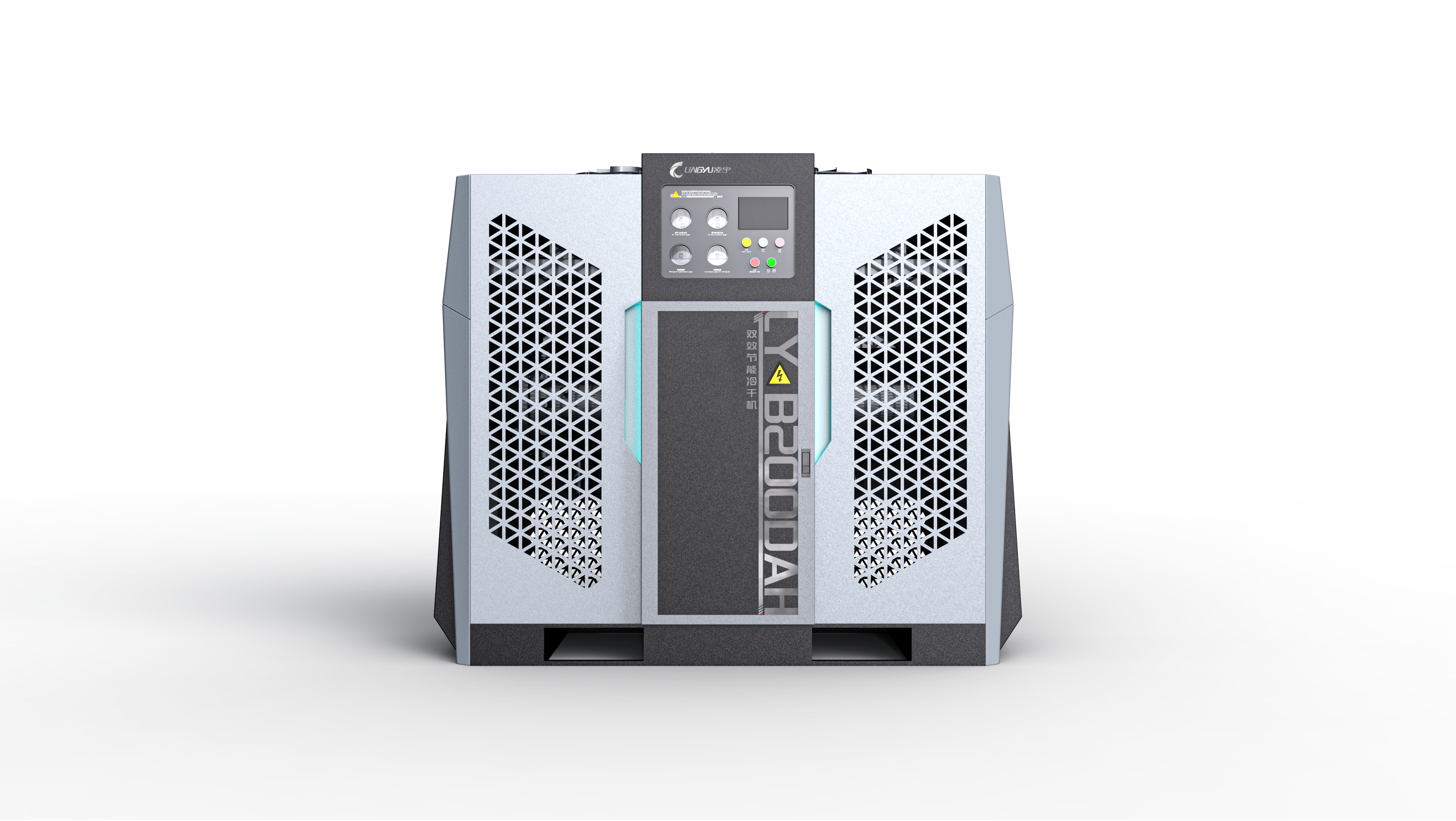
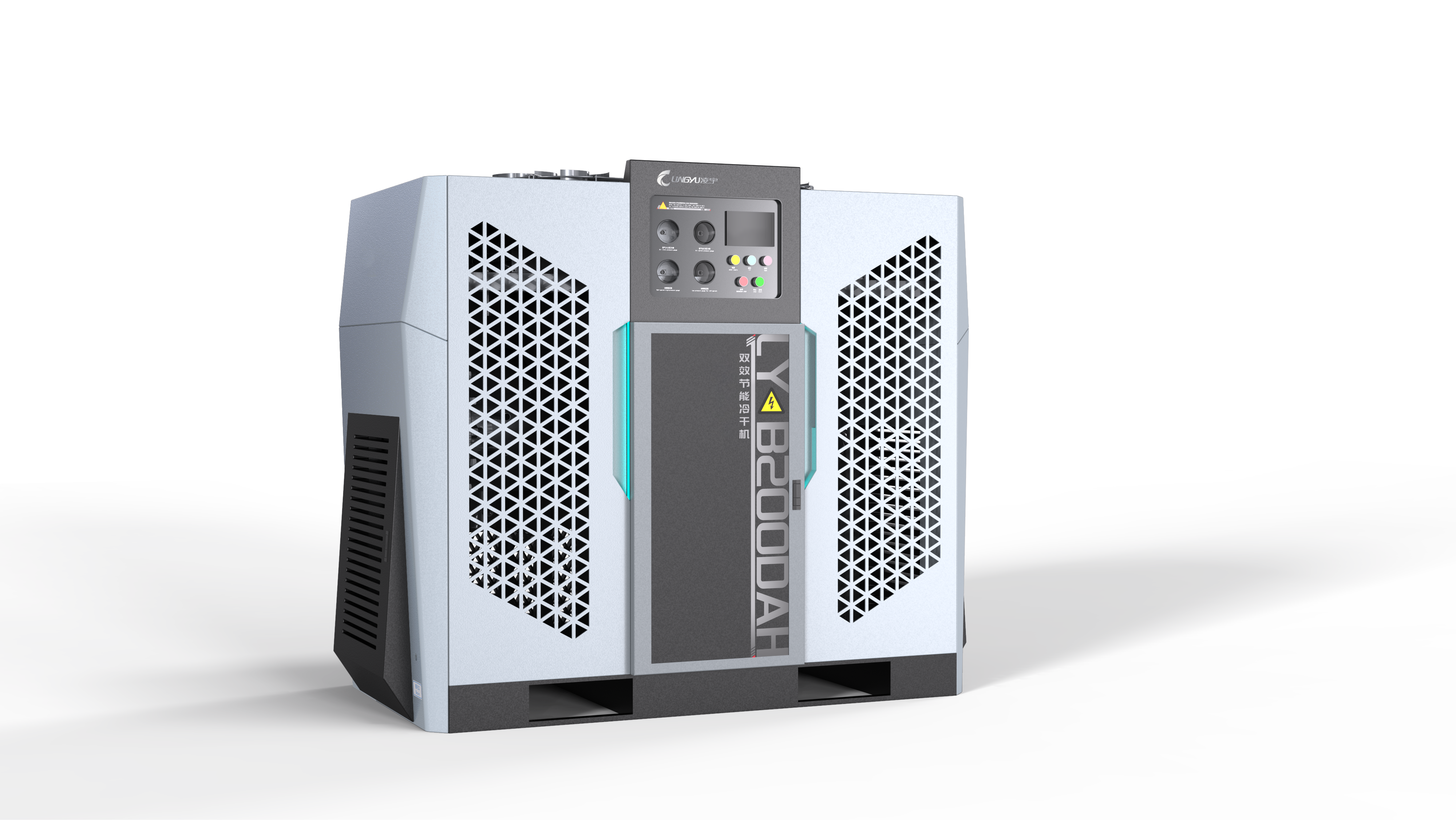
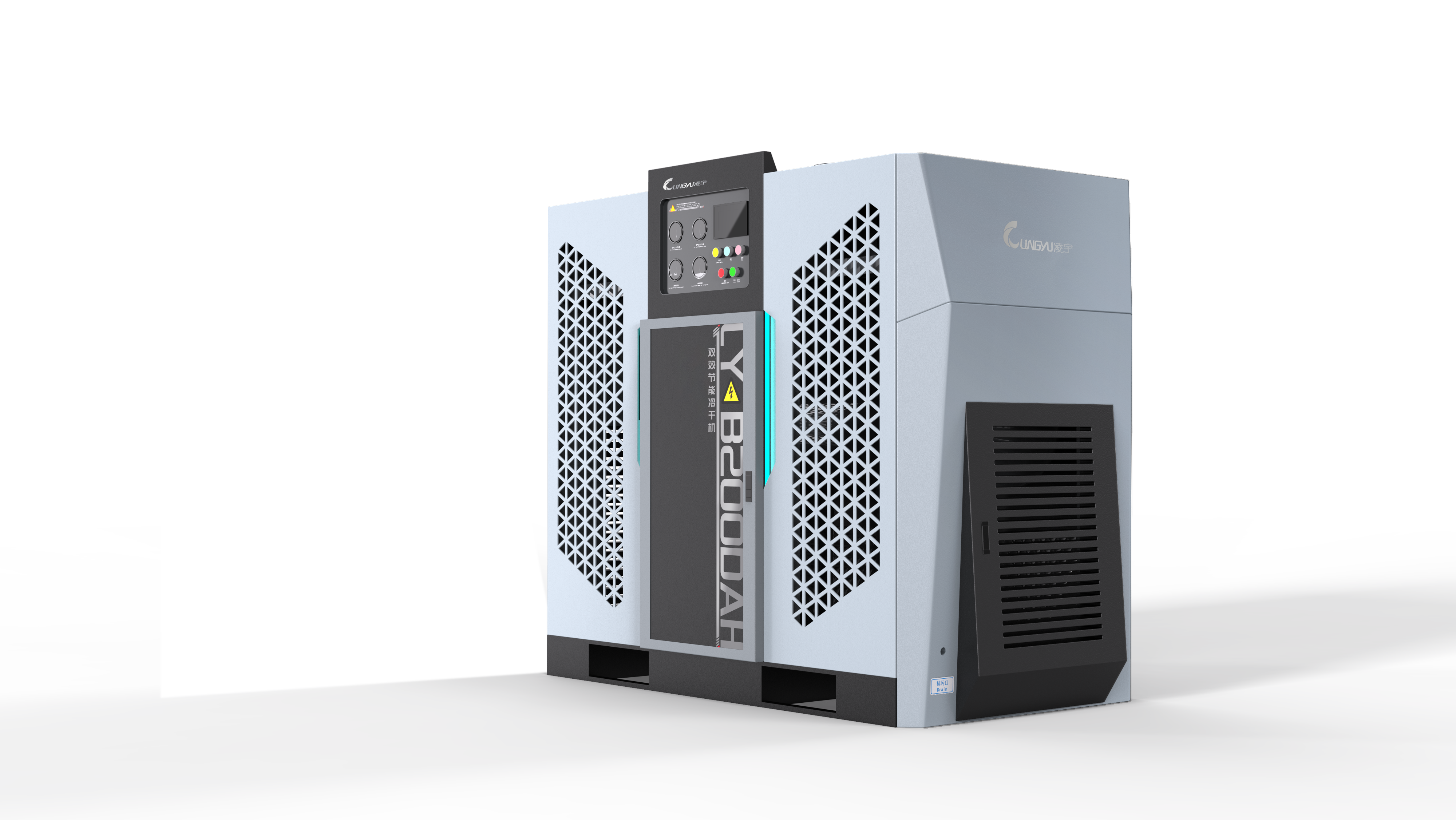
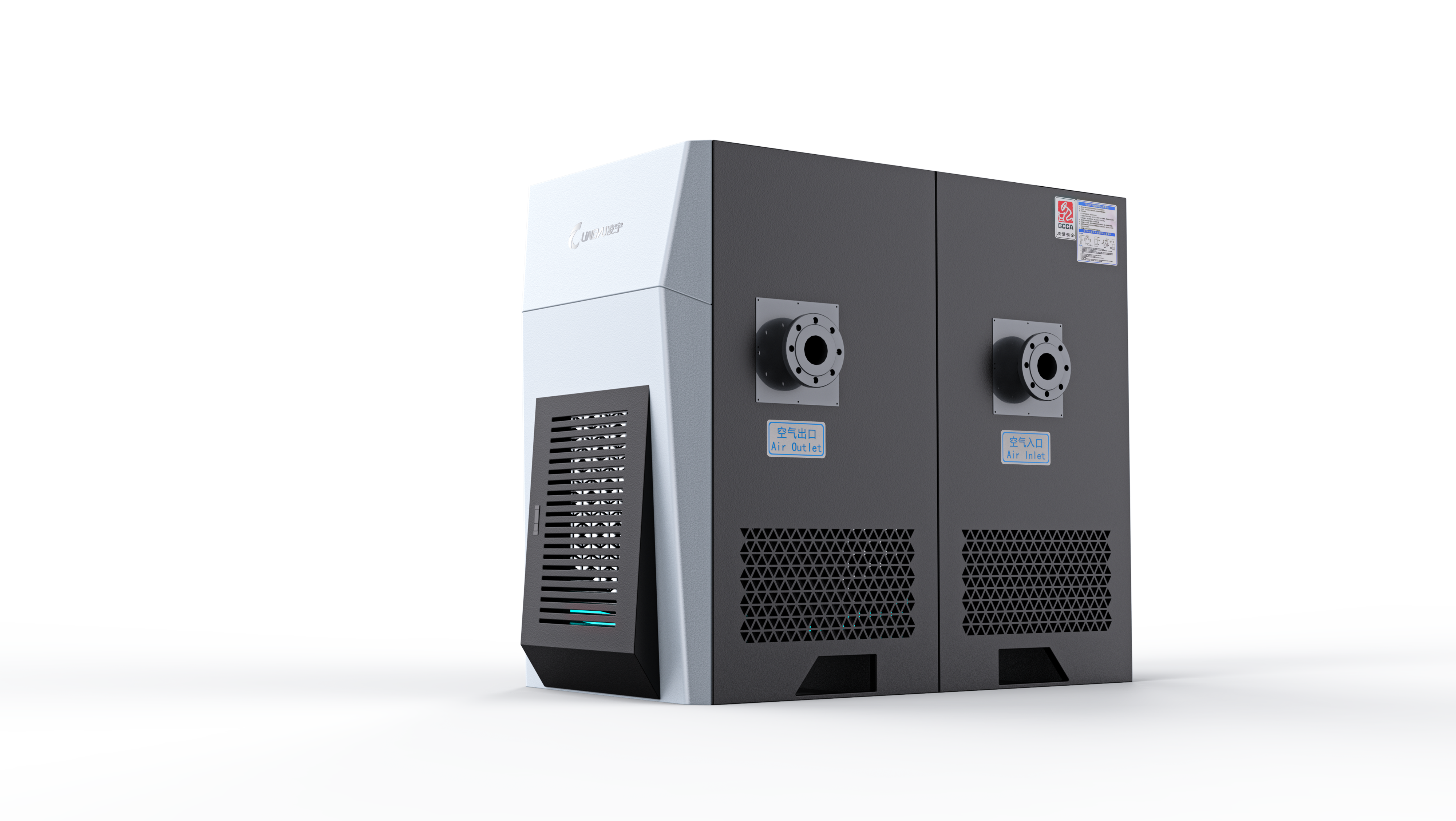
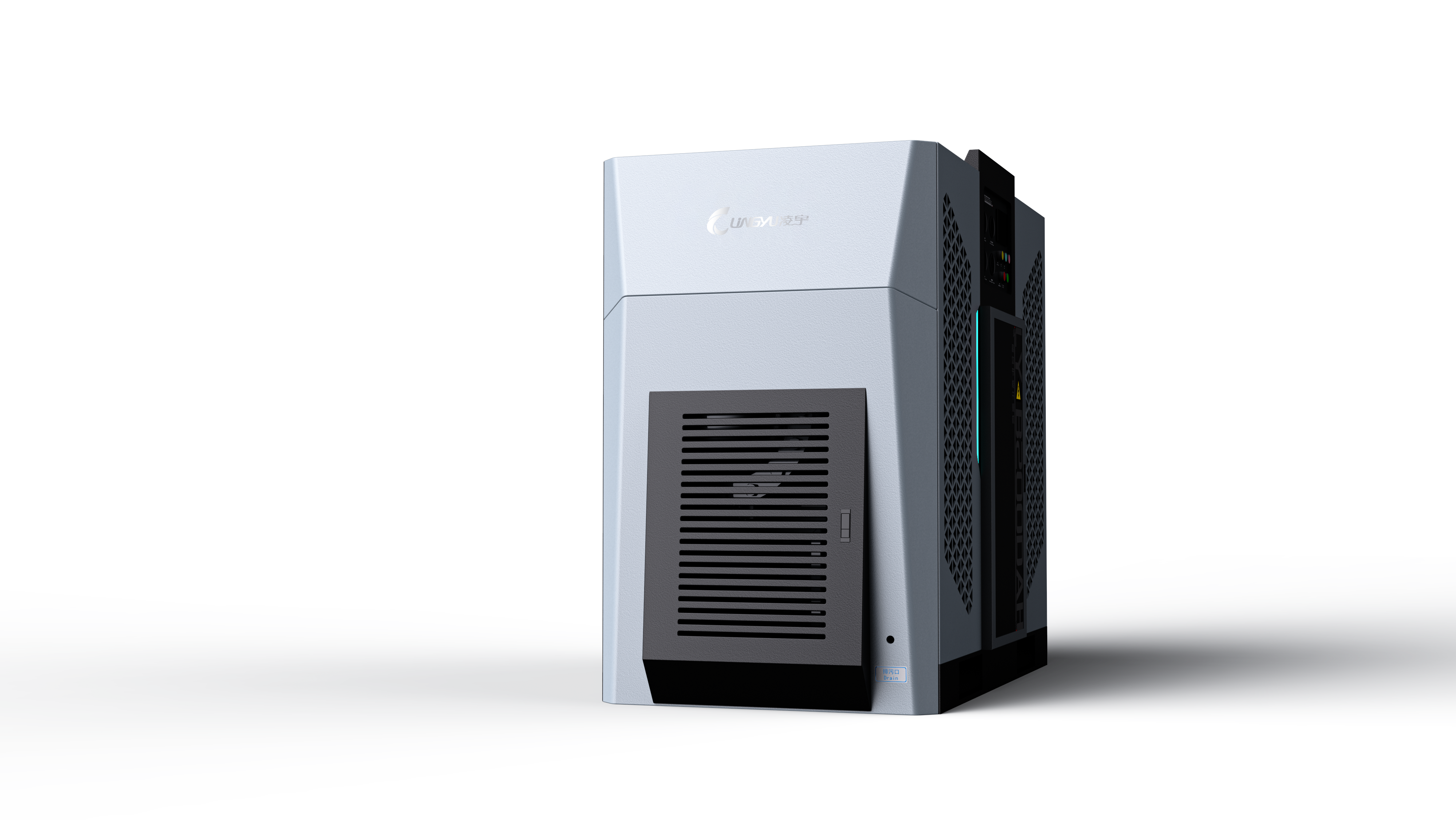
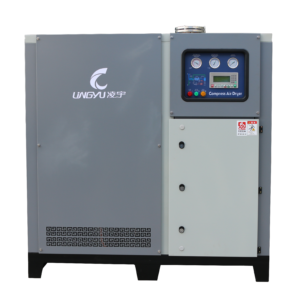
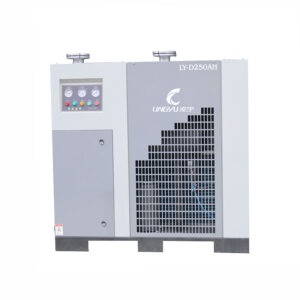
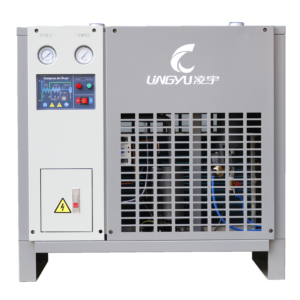
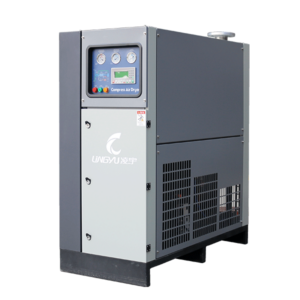
The Frequency Conversion Refrigerated Air Dryer is designed to deliver stable, energy-efficient moisture removal for industrial compressed air systems. By using variable-speed frequency conversion control, the refrigeration system automatically adjusts its operating output according to the actual air-load demand. This helps reduce energy consumption while maintaining a consistent outlet dew point.
The dryer features a centrally mounted evaporator core within the heat-exchange assembly, which reduces cooling loss and improves overall heat-transfer efficiency. As a result, more cooling capacity is directed to the pre-cooler, allowing faster temperature reduction and more effective moisture condensation.
A newly designed integrated water separator, equipped with 304 stainless-steel wire mesh, provides highly efficient vapor-liquid separation. Condensed water is removed thoroughly from the compressed air stream, ensuring clean and dry air for downstream equipment and demanding production environments.
To ensure stable performance and reliable long-term operation, the Frequency Conversion Refrigerated Air Dryer should be used under the following recommended conditions:
- Applicable fluids: Compressed air, non-corrosive air
- Rated inlet pressure: 0.7 MPa
- Allowable pressure range: 0.6–1.0 MPa, other pressure levels customizable
- Rated inlet temperature: 45°C
- Maximum inlet temperature: ≤ 60°C
- Pressure loss at full load: < 0.01 MPa
- Outlet dew point: 2°C–10°C
- Ambient temperature: Standard 35°C, operating range 2°C–45°C
- Cooling method: Air-cooled or water-cooled optional
For the best drying result, the dryer should be installed in a well-ventilated environment with stable inlet conditions. Proper pre-filtration is recommended to protect the internal heat-exchange system and maintain efficient condensate separation over long-term operation.
| Model | Flow Rate (m³/min) | Total Power (kW) | Interface Size | Weight (kg) | Dimensions (mm) |
|---|
| LY-DB30A | 3.8 | 0.44–1.25 | G1 1/2″ | 105 | 1000 × 600 × 1050 |
| LY-DB50A | 7.0 | 0.48–1.42 | G1 1/2″ | 130 | 1100 × 600 × 1100 |
| LY-DB75A | 10.5 | 0.60–1.90 | G2″ | 155 | 1250 × 700 × 1155 |
| LY-DB100A/W | 13.5 | 0.80–3.60 | G2 1/2″ | 350 | 1400 × 850 × 1350 |
| LY-DB120A/W | 17.0 | 1.02–3.61 | DN80 | 450 | 1570 × 800 × 1200 |
| LY-DB150A/W | 21.5 | 1.02–4.03 | DN80 | 480 | 1500 × 950 × 1400 |
| LY-DB180A/W | 25.0 | 1.4–5.5 | DN80 | 530 | 1835 × 940 × 1480 |
| LY-DB200A/W | 28.5 | 1.40–6.20 | DN80 | 540 | 1835 × 940 × 1480 |
| LY-DB250A/W | 32.0 | 2.02–7.58 | DN80 | 560 | 1835 × 940 × 1480 |
| LY-DB300A/W | 37.0 | 1.83–6.75 | DN100 | 680 | 1900 × 980 × 1580 |
| LY-DB400A/W | 45.0 | 2.39–9.56 | DN100 | 780 | 1900 × 980 × 1580 |
| LY-DB500A/W | 55.0 | 1.13–10.49 | DN125 | 910 | 2300 × 1000 × 1750 |
| LY-DB600A/W | 65.0 | 1.70–11.20 | DN125 | 1050 | 2300 × 1000 × 1750 |
| LY-DB700A/W | 75.0 | 4.18–12.16 | DN125 | 1100 | 2490 × 1200 × 2220 |
| LY-DB800A/W | 85.0 | 4.5–14.30 | DN125 | 1150 | 2490 × 1200 × 2220 |
| LY-DB900A/W | 95.0 | 4.6–18.8 | DN150 | 1750 | 2450 × 1200 × 2250 |
| LY-DB1100A/W | 110 | 5.1–21.2 | DN150 | 1680 | 2450 × 1200 × 2250 |
| LY-DB1200A/W | 120 | 5.6–22.8 | DN150 | 1680 | 2450 × 1200 × 2250 |
Note: For capacities above 120 m³/min, or for special requirements related to materials or inlet temperature, customized solutions are available. All data is subject to change without prior notice.
The Frequency Conversion Refrigerated Air Dryer is well suited for Middle East industrial environments that require stable dew point control, lower energy consumption, and reliable performance under variable compressed air demand. In regional operating conditions that often include high ambient temperatures, long running hours, and strong pressure on energy and water efficiency, a variable-speed refrigerated dryer offers clear advantages for plant utility air systems that do not run at a constant load. It is especially suitable for sectors such as petrochemical processing, food packaging, machinery manufacturing, printing and packaging, and building utility air applications.
Recommended Applications
- Petrochemical and Chemical Utility Air Systems – Provide stable dry compressed air for plant utility air, valves, and general process-support systems
- Food and Beverage Processing and Packaging Lines – Support dry compressed air for conveying, packaging, and production support applications
- Precision Machining, CNC, and Metal Fabrication – Help reduce moisture-related wear in pneumatic tools, machining systems, and workshop air networks
- Automotive Painting, Assembly, and Robotic Systems – Supply dry compressed air for spray coating, robotic equipment, and assembly operations
- Printing, Packaging, and Industrial Automation Lines – Maintain more stable compressed air quality for printing machines, packaging systems, and automated production lines
- Pharmaceutical Manufacturing and Clean Utility Air – Suitable for production-support environments requiring stable moisture removal and reliable operation
- Electronics Assembly and Moisture-Sensitive Production Support – Help reduce condensation risks in technical production areas and air-powered assembly tools
- Large Manufacturing Plants with Fluctuating Air Demand – A strong choice for plants where compressed air load changes throughout the day
- Central Compressor Rooms and Plant-Wide Utility Air Systems – Improve moisture control and part-load efficiency in larger factory air systems
- HVAC, District Cooling, and Building Utility Air Applications – Suitable for utility and service air systems that benefit from reliable dew point control and efficient operation
Application Note for the Middle East
For Middle East projects, this model is best positioned for indoor compressed air systems that experience load fluctuation and require better energy efficiency over long operating hours. Air-cooled versions are more suitable where good indoor ventilation can be maintained, while water-cooled versions are more appropriate for facilities with established utility support. Because regional conditions often include heat extremes and dust exposure, proper pre-filtration and stable inlet conditions are especially important to protect the heat-exchange system and maintain efficient condensate separation.
Explore More Industry Applications